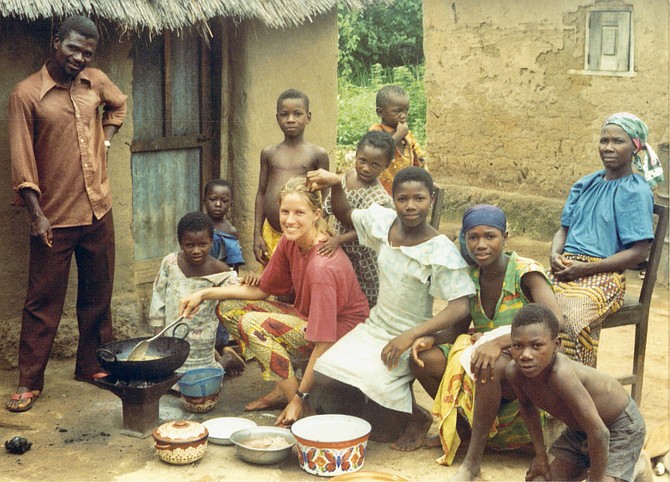
Sara Holtz, cooking and eating with her host family in Togo
Ever dream of seeing a foreign country intimately close, immersing yourself in the culture, and living as its people do; while performing service for humanity? For more than 240,000 people who have volunteered for the Peace Corps since its creation on March 1, 1961, that dream has come true. This year marks the 65th anniversary of the Peace Corps.
Congress recognized the anniversary in the Federal Register, and the Virginia General Assembly and Fairfax County Board of Supervisors also recently recognized the contributions of Returned Peace Corp Volunteers, both abroad and at home. In remarks honoring the anniversary and the volunteers, Chairman Jeff McKay and Supervisors Dalia Palchik and Walter Alcorn commended their dedication to volunteerism, community leadership and public service. More than two dozen Returned Volunteers, representing each decade of the Peace Corps, were on hand to be recognized with the County’s resolution on March 3rd.
Speaking for the group, Sara Holtz acknowledged the honor. “Today we see domestic dividends here in Fairfax County. Service moved home and service is the backbone of our community,” she said. She also invited the supervisors to consider joining the Corps, pledging the group’s assistance with the application to any who felt the call.
Assisting in just six countries at its inception, the program expanded its reach to 144 countries over the decades. The first traveled to Ghana. Today about 3,000 volunteers serve in over 60 countries. Virginia had 178 citizens volunteer in 2025. For many it means escaping the daily intrusions of the internet, social media, and even cell phones, in far less technologically advanced countries than the U.S. More than 300 have died in service, or following close of service as a result of service-related causes.
Volunteers still work to help fulfill the goal originally outlined by the Corps’ creator, President John F. Kennedy, in his inauguration address, of “advancing peace and friendship by promoting the understanding of different people and cultures on the part of Americans.”
Returned Volunteers Share Their Experiences
Jean Wintemute, of Reston, served about two and a half years in Costa Rica from 1980 to 1983. She became intrigued with the Peace Corps when she met volunteers during a trip to Venezuela in high school. “So that was my goal in life - get my bachelor’s degree and then apply to the Peace Corps,” she said. She served with her husband working on community development and health education on a Bribri Indian reservation.
The Bribri are the largest of eight indigenous groups in Costa Rica. They live in isolated mountain and coastal areas in the southern part of the country with no electricity or roads.
Wintemute shares, “My main projects were school gardens and women’s groups focusing on nutrition, basic health practices, and crafts. For nutrition, I focused on different ways to prepare food with local ingredients, such as baking banana bread, brownies, and homemade breads; and preserving fruits during harvest time. Women would make and sell banana bread for extra cash.” A plan to teach making jam out of local apples did not go well due to inadequate apple supplies. Wintemute later discovered a local superstition: if you cook the apples taken from the trees, the trees will die. No one was willing to offer the fruit for the lesson.
“For my craft project, I brought in a small loom and started weaving in my spare time. The women were so intrigued as they remembered their ancestors weaving, so we devised an easy loom to build and started weaving classes.” She shares that although originally intended to be a spare time hobby, the village women were able to sell their bags, creating an income source. During a visit to the site in 2025, she saw a young man still using one of the bags the women had woven; still in great shape. While serving, Wintemute says she missed amenities such as refrigeration, electricity, and the variety of foods we enjoy in our supermarkets. Now she misses all the fresh tropical fruit, which she judges to be far superior to that on offer here.
Responding to President Kennedy’s call in the early years of the Peace Corps was Stephen Cristofer, of Reston, who served for two years from 1962 to 1964 in Eritrea/Ethiopia. The two countries now are neighbors in east Africa; the former located on the Red Sea, the later land-locked, sharing borders with Somalia and Kenya, At the time of his service, they were one country. Working as a federal examiner at the time he joined, Cristofer felt called by the spirit of adventure. He would teach English and geography at primary, middle and high school levels as his service project in Africa. Absorbing the customs of daily life in a new country, Cristofer recalls, with humor, being admonished by the headmaster at his first teaching assignment. “I was taught not to put toilet paper in the toilet, both because it jammed up the system, and the wastewater flowed out to nurture the garden, in which the outhouse was located.” Cristofer relates that while there he most missed family and friends, and the comforts of home. He can keep memories and the foods of Africa fresh in memory here given Northern Virginia’s large Eritrean/Ethiopian community. He eats out frequently at Ethiopian restaurants.
Eritrea, although having extensive agriculture and mineral resources remains one of Africa’s poorest nations. Ethiopia is the tenth largest and second most populated country in Africa. It is recognized as having among the oldest remains of a human ancestor yet discovered.
Sara Holtz, of Oakton, served for three years in Togo, from 1995-1998. She promoted community health with a focus on safe motherhood, child survival and reproductive health. Holtz shared, “I missed family and friends, but my two Togolese counterparts Henou and Adjoua welcomed me into their own families. For 23 years, Henou and I maintained our friendship through the slow, irregular pace of handwritten letters in French. In 2021 I received a WhatsApp voice memo from an unknown number and heard his voice for the first time since I left in 1998. I still find myself craving fufu with peanut-sesame sauce and tchouk — the home brew prepared by Kabye women and served, still fermenting, in a calabash.”
Togo is in West Africa, sandwiched between Ghana and Nigeria. It’s known for its palm tree lined beaches and hilltop villages. One of the poorest nations in West Africa, Holtz says they still need much: “better roads, protection from Jihadist incursions, poverty alleviation, reversal of deforestation, more diversified economy, political stability, and gender equality.”
“Serving as a Peace Corps Volunteer was the privilege of a lifetime, instilling in me a lifelong commitment to service,” Holtz says. “Having gained far more than I gave, I try to pay it forward by volunteering in my community — most recently through habitat restoration, youth development, and refugee resettlement initiatives in Fairfax County.”
The Peace Corp volunteers receive no salary, but are paid a monthly allowance for living expenses in United States dollars that is sufficient to live at a level comparable with host country counterparts. According to the Peace Corps, “It can be challenging to eat a well-balanced meal during some seasons and the variety of foods may be limited. Western style foods will be rare additions to a Volunteer’s diet.”
Holtz sums up missing the ethnic foods this way. “Truthfully, I miss the sense of family and community found in a communal bowl more than the food itself. Today I try to recreate that feeling by inviting friends to gather and eat together, honoring the lesson that the meal’s best ingredients are the connection and time we share.”