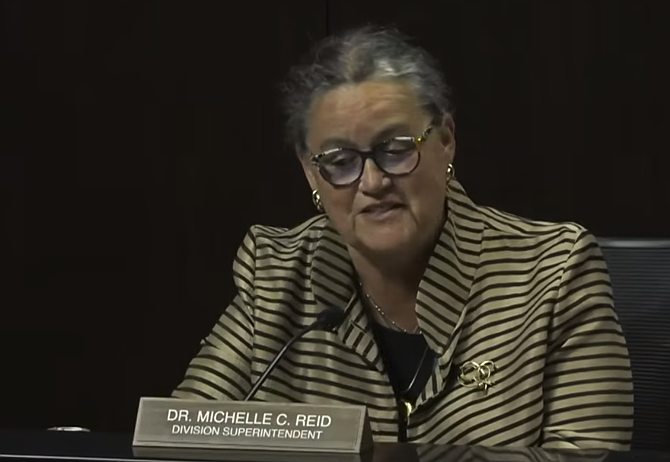
<cl>FCPS Superintendent Dr. Michelle Reid
Facing a $28.9 million budget shortfall, the Fairfax County School Board unanimously passed a tightened $4.1 billion fiscal year 2027 budget on May 21. The board then voted 10–2 to approve a separate follow-on motion from At-Large Member Kyle McDaniel directing the superintendent to develop a public guide outlining the division’s financial management principles. The directive drew opposition from Hunter Mill member Melanie Meren and Mount Vernon member Mateo Dunne.
Compounding Fiscal Strains
The current shortfall marks a departure from the first two years of Superintendent Dr. Michelle Reid's tenure (fiscal 2024 and fiscal 2025), during which the county fully funded her budget requests. Financial strain arose due to compounding pressures.
Because no state budget has been approved yet, Virginia cannot tell local school districts exactly how much funding they will receive for the upcoming school year. Furthermore, the state's funding formula underestimates the actual cost of competitive teacher salaries, special education and support staff, forcing counties like Fairfax with higher costs to pay more to maintain baseline standards, according to a JLARC study.
Salary hikes from the 2024 collective bargaining agreements outpaced real estate tax revenues once federal pandemic aid expired.
To balance the budget, the school board was forced to reduce staffing reserves, delay digital device refreshes, reduce math materials, and defer the micro-credentialing fund. However, they successfully protected the collective bargaining agreements, middle school after-school programs, and the VIP camp.
McDaniel noted that the motion aimed to mirror the Board of Supervisors’ 1975 "10 Principles of Sound Financial Management." The objective incorporates existing tools, such as Executive Limitation 5, or EL-5, which governs financial planning and budgeting. Under FCPS's "Coherent Governance" model, Executive Limitations serve as operational guardrails set by the school board, defining boundaries the superintendent must not cross.
Supporters included McDaniel, Dr. Ricardy Anderson (Mason District) and At-Large Member Ilryong Moon. McDaniel emphasized its value as a long-term public message that would condense complex regulations into a digestible format. Anderson said that she wants to see the strategies staff "open up the curtain" on the budget process. “I want to see that homework,” she said. Once it was clarified during the discussion that the follow-on motion was intended to be an accumulation of existing practices rather than the creation of something new, Moon said, “I am supporting the motion.”
Opponents Melanie Meren (Hunter Mill District) and Mateo Dunn (Mount Vernon District) countered that FCPS already has extensive policies and an award-winning record of financial management, including Baldrige recognition.
During the discussion on financial management principles, Meren said, “This work is too important to delegate to the superintendent, and before we implement more frameworks, we must hold the superintendent accountable to what’s already in place.” Meren added that she was unwilling to ask the superintendent to spend limited staff time and resources on a new review category when existing executive limitations, policies, and budget processes were already in place.
Dunn also opposed the motion, cautioning that creating a standalone document without explicit reporting mechanisms amounts to an empty gesture.
"Just to put principles out there and not live up to them … It’s just words on the wall," Dunn said. "I have a bias toward action and outcomes, and I don’t think this gets us to either."
In a 10–2 majority, the school board approved the motion, directing the superintendent to bring the draft framework back for discussion at a Budget Committee of the Whole meeting by September 2026.